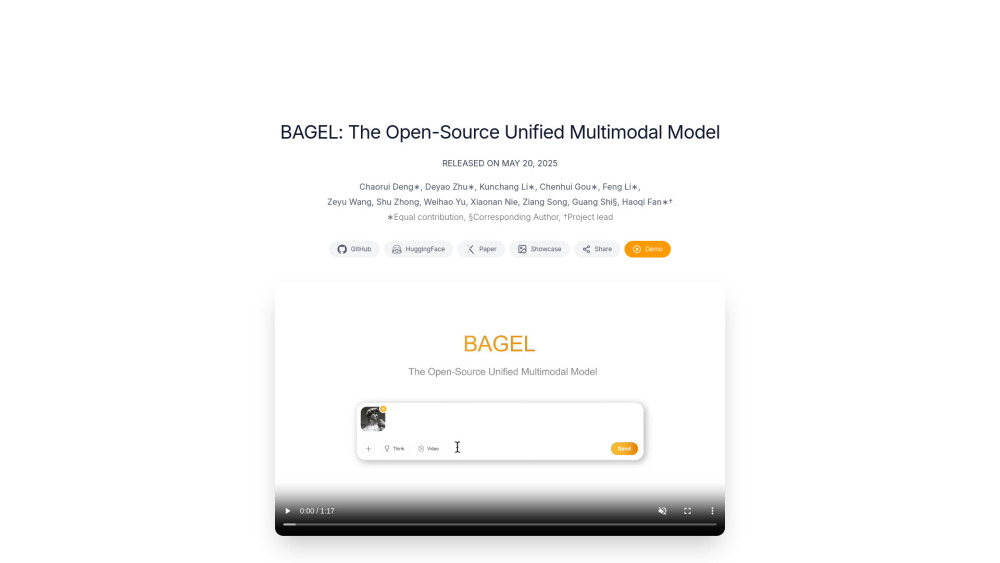
BAGEL
Open-source unified multimodal AI for understanding, generation, editing.
Screenshots
Overview
BAGEL is an open-source, unified multimodal AI framework designed to handle a broad spectrum of tasks including understanding, generation, and editing across text, images, audio, and video. It provides a single, cohesive architecture that can process and produce multiple modalities simultaneously, enabling complex workflows like generating an image from a text description while also analyzing its content or editing it based on a voice command. As an open-source project, BAGEL empowers developers and researchers to customize, extend, and deploy the model on their own infrastructure, fostering innovation in AI applications. Its unified nature reduces the need for piecing together multiple separate models, streamlining pipelines for content creation, data analysis, and interactive applications. BAGEL represents a step toward more integrated, human-like AI systems that understand and manipulate the world in richer ways.
How to Use
Install BAGEL from its open-source repository and load the model into your preferred Python environment. Use its API to pass multimodal inputs (e.g., an image and a text prompt) and configure the desired operation—understanding, generation, or editing—then run the pipeline to get your output.
Core Features
Use Cases
- 1 Describing and understanding images (e.g., 'Tell me about this picture')
- 2 Generating photorealistic images from text prompts (e.g., 'a photo of three antique glass magic potions')
- 3 Editing images while preserving details (e.g., 'He squatted down and touched a dog's head')
- 4 Transforming image styles (e.g., 'Change to 3D animated style')
- 5 Navigating and interacting with virtual environments (e.g., 'After 0.40s, move forward')
- 6 Engaging in multi-turn conversations with compositional reasoning (e.g., creating a slogan for a doll)
- 7 Refining prompts for detailed and coherent visual outputs using a 'thinking' mode
Frequently Asked Questions
What makes BAGEL different from other AI tools?
Is BAGEL free to use?
Who would benefit most from BAGEL?
Quick Info
- Category
- Image Generation & Editing
- Subcategory
- Text to Image
- Added on
- May 26 2025
- Monthly Visits
- 19.0K
- Rating
- 5.0 / 5.0
- Saved
- 1


